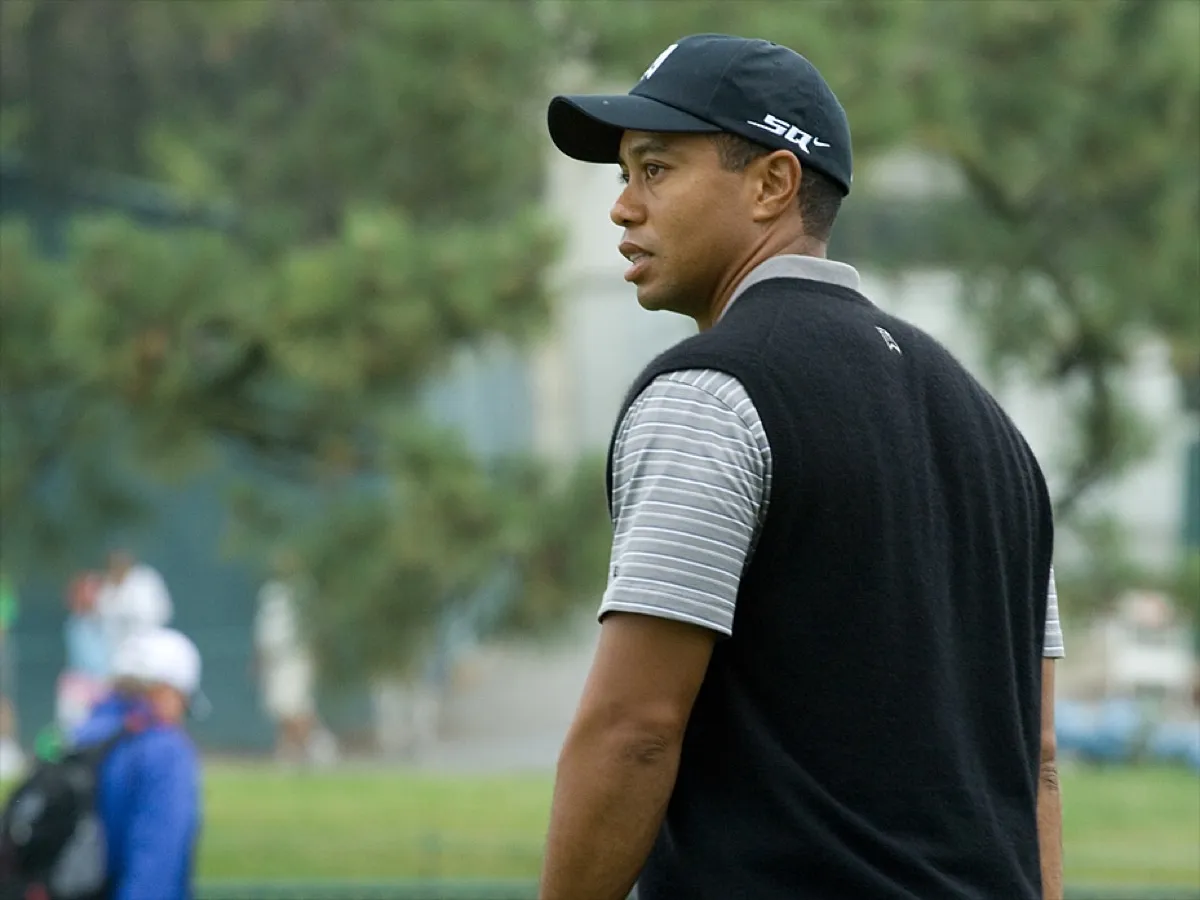
Tiger Woods is the most transformational figure in the history of professional golf. With 15 major championships and 82 PGA Tour victories, Woods changed not only how golf was played but how it was perceived globally. His legendary comeback from career-threatening personal and physical setbacks culminated in one of sport's greatest redemption stories - a fifth Masters victory in 2019 that reaffirmed his status as golf's ultimate competitor.
Quick Facts
| Full name | Eldrick Tont "Tiger" Woods |
| Date of birth | 30 December 1975 |
| Age | 50 |
| Nationality | American |
| Height | 6'1" (185 cm) |
| Turned pro | 1996 |
| College | Stanford University |
| Major wins | 15 (5 Masters, 3 U.S. Open, 3 The Open, 4 PGA) |
| PGA Tour wins | 82 |
| Current tour | PGA Tour (no official start since the 2024 Open Championship) |
Early Dominance and Amateur Career
Born on 30 December 1975 in Cypress, California, Eldrick Tont "Tiger" Woods showed prodigious talent from infancy. He appeared on television hitting golf balls at age two and won the first of three consecutive U.S. Amateur titles at age 18. His amateur career included records that still stand today, and his decision to turn professional in 1996 at age 20 sent shockwaves through the golf world.
Woods's entrance into professional golf was nothing short of seismic. Within months, he had won his first PGA Tour event and announced himself as the future of the game. His combination of power, precision, mental fortitude and competitive fire was unlike anything the sport had seen.
The Major Championship Record
Woods's 15 major championships span more than two decades and include some of the most memorable victories in golf history:
Masters Tournament (5 victories)
Woods's relationship with Augusta National began with his record-breaking 12-stroke victory in 1997 at age 21, making him the youngest Masters champion in history. That victory shattered course records and announced a new era in professional golf. His subsequent Masters victories in 2001, 2002 and 2005 were equally dominant displays of precision and power around Augusta's demanding layout.
The 2019 Masters triumph stands as perhaps the most emotional and significant victory of his career. After years of injury struggles and personal difficulties, Woods rolled back the years with a methodical, controlled performance that culminated in one of sport's greatest comeback stories. The roar when his final putt dropped will echo through golf history.
For more on the tournament where Woods has found his greatest success, see our Masters 2026 results.
U.S. Open (3 victories)
Woods's U.S. Open victories showcased his ability to excel under the most demanding conditions. His 15-stroke win at Pebble Beach in 2000 remains one of the most dominant major championship performances ever, whilst his playoff victory at Torrey Pines in 2008 - achieved on a broken leg - demonstrated the mental toughness that defined his career.
The Open Championship (3 victories)
The Claret Jug came to Woods three times, including two victories at St Andrews in 2000 and 2005, and a successful defence at Royal Liverpool in 2006. His mastery of links golf proved his adaptability and complete command of the game's varied demands.
PGA Championship (4 victories)
Woods's four PGA Championship victories spanned from 1999 to 2007, including the famous duel with Bob May at Valhalla in 2000, which went to a three-hole aggregate playoff that Woods won by a single stroke.
The Tiger Slam and World Domination
Woods's period of complete dominance from 1999 to 2008 redefined what was possible in professional golf. His achievement of holding all four major championships simultaneously - the "Tiger Slam" from 2000-2001 - remains one of sport's most extraordinary accomplishments.
During his prime years, Woods held the world number one ranking for 683 weeks in total, a record that may never be broken. His statistical dominance was unprecedented, leading the PGA Tour in virtually every meaningful category whilst winning at a rate that dwarfed his contemporaries.
The Comeback Story
Woods's career took a dramatic turn in the late 2000s. Multiple back surgeries and questions about whether he would ever return to form made his situation appear hopeless. For nearly a decade, golf's greatest champion struggled with injury and inconsistency, leading many to write off any chance of additional major victories.
The 2019 Masters changed everything. Woods's methodical dismantling of the field over four days culminated in a one-stroke victory that sent shockwaves through the sporting world. The image of him embracing his son Charlie as he walked off the 18th green at Augusta provided a poignant bookend to a career that had given golf some of its highest highs and lowest lows.
Impact on the Game
Woods's influence extends far beyond his championship record. He transformed golf's global appeal, bringing new audiences to the sport and inspiring a generation of players from diverse backgrounds. Prize money on professional tours increased exponentially during his peak years, as television ratings and sponsorship deals reached unprecedented levels.
His impact on golf course design, equipment technology and fitness regimens changed how the game was approached at every level. Woods proved that golf could produce global superstars who transcended their sport, paving the way for today's international stars.
2026
Woods did not start an official PGA Tour event in 2026. He came into the year recovering from lumbar disc replacement surgery in October 2025, his latest back operation, on top of the left Achilles he ruptured in March 2025.
His only competitive golf came in TGL. Woods made his season debut for Jupiter Links in Match 2 of the SoFi Cup Finals in March, alongside Max Homa and Tom Kim. Los Angeles Golf Club won 9-2 to sweep the best-of-three series. "They steamrolled us at the end tonight," Woods said.
On 31 March he announced he was stepping away from golf for a period of time.
He missed the Masters the following week. On 1 April the PGA of America announced he would not captain the U.S. team at the 2027 Ryder Cup. He played none of the four majors, his second straight season without one.
The boardroom kept him busy. Woods resurfaced in public at the Travelers Championship in June, where the Tour unveiled the work of his Future Competition Committee: a Championship Series and a Challenger Series, with promotion and relegation, starting in 2028. He is scheduled to host the Hero World Challenge in the Bahamas from 3 to 6 December.
Playing Style and Physical Approach
Woods revolutionised how golf was played:
- Power and precision - Combined unprecedented distance with laser-like accuracy, making courses that challenged previous generations seem outdated
- Mental game - Possessed an almost supernatural ability to raise his level during crucial moments
- Short game mastery - His creativity and touch around greens, particularly under pressure, set new standards for what was possible
- Fitness revolution - Brought athletic training and conditioning to golf, transforming players' approach to physical preparation
- Course management - Strategic brilliance that allowed him to maximise scoring opportunities whilst minimising risk
The Modern Era
Woods's recent years have been defined by injury and absence. Since his 2021 car crash he has made all four rounds of a major only twice, at the 2022 and 2024 Masters, and he has not started an official PGA Tour event since the 2024 Open Championship. Each appearance still generates enormous interest, as fans and media await signs of the magic that defined his career.
His influence now runs through the boardroom. Woods sits on the PGA Tour Policy Board and chairs its Future Competition Committee, the group behind the two-series model the Tour will adopt in 2028.
Legacy and Cultural Impact
Woods's legacy transcends statistics. He made golf relevant to mainstream culture in ways the sport had never achieved, inspiring countless young players to take up the game. His influence on equipment, course design, fitness and mental preparation created ripple effects that continue to shape professional golf today.
His 683 total weeks and 281 consecutive weeks at the top of the OWGR world rankings are both records, and remain the benchmark every world number one is measured against.
Tiger Woods Statistics at a Glance
| Category | Detail |
|---|---|
| Nationality | American |
| Born | 30 December 1975 |
| Turned professional | 1996 |
| Major championships | 15 |
| PGA Tour wins | 82 |
| Masters victories | 5 |
| Weeks at world number one | 683 |
| FedExCup titles | 2 |
| Career prize money | $120,999,166 (official PGA Tour money, a Tour record) |
Frequently Asked Questions
How many majors has Tiger Woods won?
Woods has won 15 major championships, second only to Jack Nicklaus's record of 18. His majors span five Masters, four PGA Championships, three U.S. Opens and three Open Championships.
What was Tiger Woods's greatest comeback?
The 2019 Masters victory stands as Woods's greatest comeback. After years of injury struggles and personal difficulties, his return to major championship glory at age 43 was one of sport's most remarkable redemption stories.
Is Tiger Woods still competing professionally?
Not in official events. His last PGA Tour start was the 2024 Open Championship, and his only competitive golf in 2026 was one TGL finals match for Jupiter Links in March before he stepped away from golf.
Will Tiger Woods play in future Ryder Cups?
Not as a player. He declined the U.S. captaincy for 2027 at Adare Manor, announced by the PGA of America on 1 April 2026. See our Ryder Cup 2027 preview for more.
GolfMode is on its way. Join the waitlist to follow Tiger Woods's legacy when it launches.
Published by GolfMode Editorial. Every article is researched and fact-checked against official tour and championship sources, and updated when the facts change. Learn about our editorial approach.
GolfMode App · Coming soon
Live scores, coming soon.
We are building real-time scores, player alerts and hole-by-hole tracking across the tours. Join the waitlist to hear when it launches.
Join the Waitlist